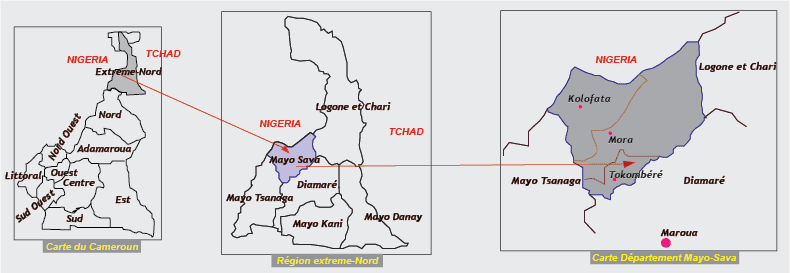
The Commune of Tokombéré was created by decree N°82/455 of September 20, 1982. Before its creation it was part of the Commune of Mora, Several appointed Mayors directed this Commune, Until 1995 and it is only in 1996 there was the first municipal election which opened the door to the municipality to elected mayors.
Tokombéré was born around the 1960s with the arrival of Catholic missionaries. Its name comes from Kudumbar in Zoulgo which means the place of combat. All the ethnic groups that make up this Commune are autochthonous apart from a few rare Mandara and Fulani encountered in the town of Tokombéré.
The historical profile of the Commune of Tokombéré is recorded in the table below:
Table 1: Historical profile of the Commune of Tokombéré
Created by decree N°82/455 of September 20, 1982, the Municipality of Tokombéré has an area of 552 km2.
Located in the department of Mayo-Sava, region of the far North, the municipality of Tokombéré is limited:
To the north by the Municipality of Mora,
To the south by the municipality of Méri,
To the west by the municipality of Soulédé-Roua,
And to the east by the town of Pétté.
The total population of the Tokombéré Commune according to the general census of the population of Cameroon in 2005 is estimated at 91,256 inhabitants, including 47,070 women or 51.58% and 44,186 men or 48.42%. This population is distributed in the 35 villages that make up the Commune with a high density in the urban space.
Several ethnic groups live in the Commune, the most important of which are: the Mada, the Zoulgo, the mouyeng, the Molko, the Mandara, the Gemjeck, the Guiziga, the ouldémé, the Bokou and the Bornoua. The different ethnic groups maintain good relations with each other and with the administrative authority.
The dominant religions are Christianity, Animism and Islam. The practitioners of these religions tolerate each other and also maintain good collaboration with the administration.
There are 6 second degree traditional chiefdoms in the Commune (Mada, Serawa, Makilingai, Ouldémé, Mouyengué and Palbara) at the head of which is a canton chief. Each canton is made up of villages placed under the authority of Lawane. The villages are subdivided into quarters headed by a Blama. The Blama are accountable to the Lawanes and they in turn to the chiefs of cantons. All these traditional chiefs are auxiliaries to the administration and each report to his hierarchical superior as far as he is concerned.
In the Commune we meet the Habitats built in definitive and semi-definitive materials. Habitats constructed of non-durable temporary materials. Generally these dwellings in temporary materials are made from rammed earth or mud bricks and the straw roof which is attacked by termites a day later after the establishment. He noted that these dwellings have an average duration of one to two years. These inhabitants are called to build their house almost all the time of their life.
Those called semi-permanent materials are built from earthen bricks and cement joints. These habitats have a more or less long lifespan. The owners are generally more or less wealthy.
On the other hand, dwellings made of permanent materials are built entirely of cement, from the foundation to the walls. These types of dwellings are built by wealthy people.
The main economic activities identified in the Commune are: agriculture, livestock, crafts, processing of agricultural products, and small trade. cereal (rainy season sorghum, dry season sorghum, maize), cotton, onion, sugar cane, peanuts, cowpea and vouandzou.